Refund Execution Controls for Mid-Market Ecommerce
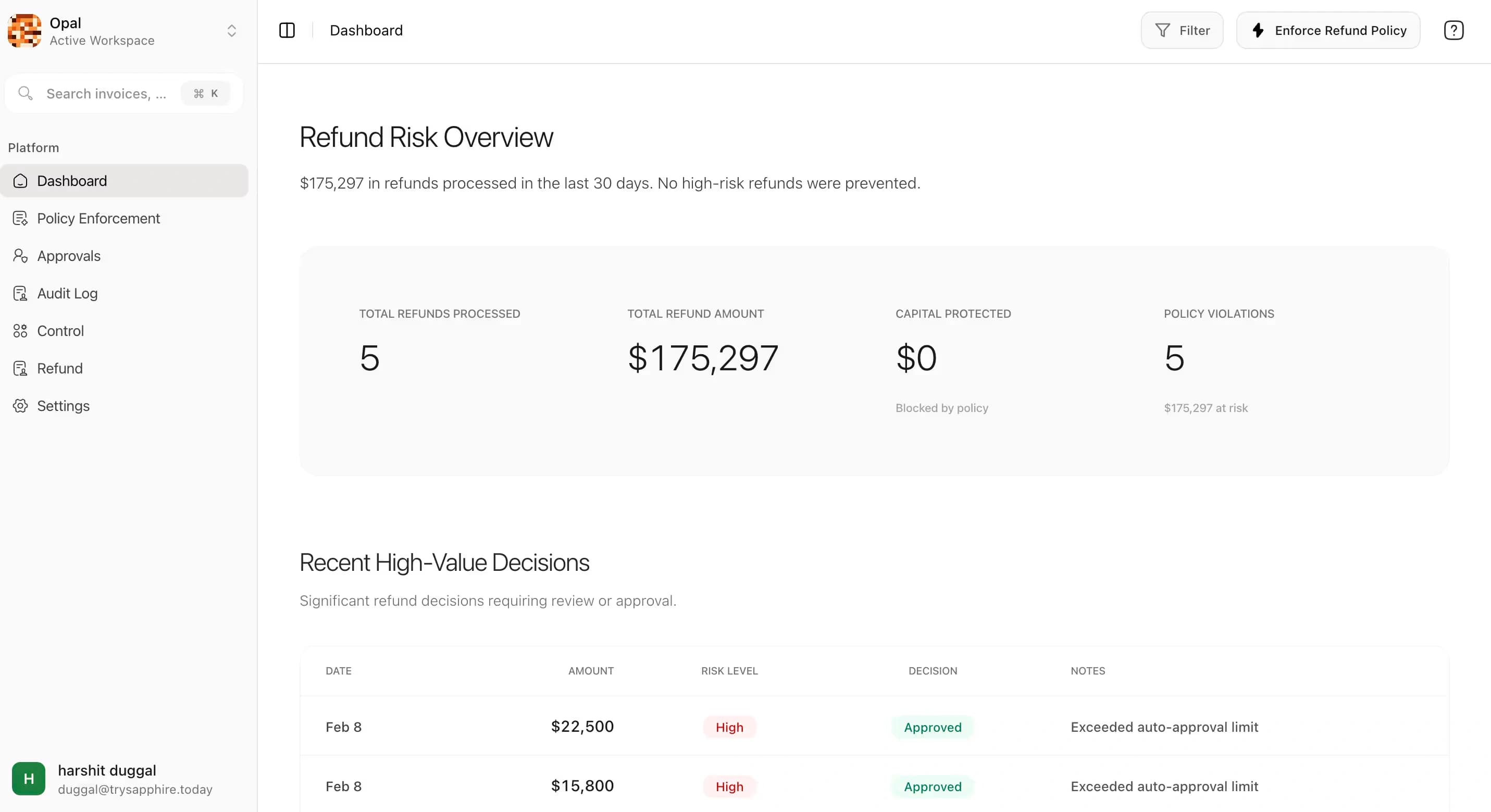
Policy-breaching refunds constitute capital control failures. Opal enforces deterministic authorization at execution, blocking unauthorized disbursements before funds exit the enterprise.

Inhigh-volumeecommerceoperations,unauthorizedrefundexposureisnotidentifiedatexecution—itisidentifiedinreconciliation.Bythatpoint,capitalhasleftthebusiness,approvalchainsareundocumented,andpolicyviolationsareapermanentrecordratherthanapreventedloss.Atscale,uncontrolledrefundexecutionisnotanoperationalgap.Itisagovernancefailurewithacompoundingandunrecoverablecost.
Deterministic policy enforcement applied at every refund authorization

Threshold enforcement. Transactions above approved limits are blocked at authorization.

Return window enforcement. Refunds outside approved windows route to documented approval paths.

Conflict detection. Replacement and store credit conflicts are detected and blocked.

Approval routing. Manager, finance, or dual approval triggered by transaction materiality.
Policy enforcement for enterprise refunds at authorization.

Real-Time Policy Enforcement
Every refund is evaluated against policy. Compliant transactions proceed. Non-compliant transactions are blocked or routed. No agent discretion beyond configured limits.
Complete Attribution
Every decision is logged with policy reason codes. Full audit trail for every blocked transaction. Finance-grade reporting on prevented losses.
Tiered Approval Workflows
Transactions route by dollar value, risk profile, and materiality. Manager, finance, or dual approval triggered by thresholds and frequency caps.
of refunds blocked prior to disbursement
monthly capital leakage prevented
The cost of
refund leakage.
Without enforcement, controls drift. High-volume teams exceed thresholds. Return windows collapse. Finance discovers violations after capital moves. Opal blocks execution and enforces policy.
of refunds breach policy in high-volume commerce under audit pressure.
average refund value across enterprise commerce and SaaS.
monthly leakage reduction after deterministic enforcement activation.
Frequently asked questions
No. Opal functions as a control layer within your existing support infrastructure. It intercepts refund requests at execution and applies policy rules, while your support platform continues to handle customer communication.
Implementation connects via API to your existing environments. Policy rules are configured through the Opal dashboard. No storefront modifications or workflow redesigns are required.
No. Opal is a deterministic control engine. AI is used exclusively to quantify financial risk and surface material exposure. AI does not approve or deny refunds. Deterministic rules control execution, maintaining audit defensibility.
Policy rules apply at execution. When a transaction exceeds defined thresholds, it routes through the configured approval hierarchy. Exceptions require explicit authorization from designated approvers, creating an audit trail for each override.
Every intercepted transaction logs the policy violation, threshold breached, and final disposition. Finance teams receive reporting on control activity, including prevented loss and authorization patterns.
Opal controls policy on capital release. Pricing reflects the transaction volume under control, aligning cost with the scope of financial control provided.